
The Man They Wanted

Programming note: I’ll be live with Mark Halperin on Two Way at 9:00 a.m. ET. Watch here.
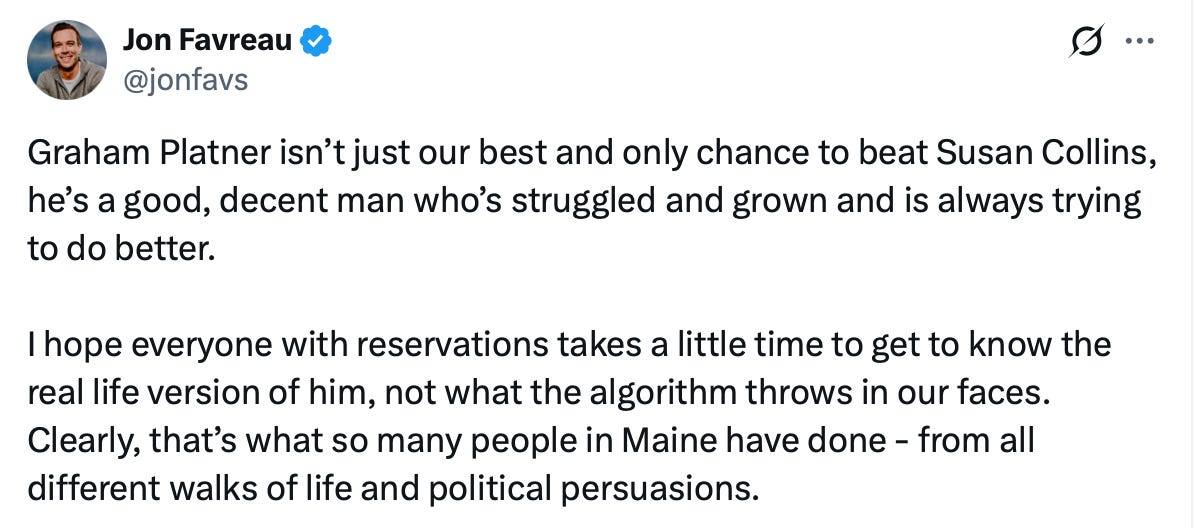
Democrats did not stumble into Graham Platner. They went looking for him.
For a decade, the party has been losing men — young men, blue-collar men, veterans, the guys who fix your truck and pour your beer. So the smart set decided they needed a man who could win those men back. Not a policy fix. A vibe. And when they went hunting for the most aggressively masculine figure they could find in a swing state, they landed on a Marine with a Nazi death’s-head tattooed over his heart. That should tell you something about how the modern left thinks masculinity works. They didn’t want a good man. They wanted a hard one, and they weren’t careful about the difference.
On Monday, Politico reported that Jenny Racicot, a 41-year-old Maine woman who dated Platner on and off for more than two years, says that in 2021 he came into her home uninvited and drunk and forced her to have sex while she repeatedly told him to stop. Politico corroborated her account through emails to her therapist and two people she confided in at the time. Platner calls it “categorically untrue.” Within hours, Ro Khanna yanked his endorsement, and the leadership of the Maine Democratic Party — the same people who nominated him — asked him to leave the race.
Here is the part that ought to enrage you if you care about how the press does its job. Racicot’s allegation is not new to reporters. She was in the New York Times’ big Platner exposé last month. The Times just chose not to print the assault. It quoted her saying only that he was “reckless” and “unsettling” and “does not respect women,” and left the rest on the cutting room floor. She has since said she was conflicted about telling her full story because she agrees with Platner politically — which is precisely the kind of witness whose account carries weight, since she had every partisan reason to stay quiet.
So what did the Times run with instead? Lyndsey Fifield. And it made sure — early, and often — to label her “a Virginia conservative who has worked for right-leaning groups and Republican campaigns.” That framing was a gift, and Platner’s campaign unwrapped it immediately, dismissing Fifield as a “GOP operative.” The paper handed Democrats their talking point on a silver tray: don’t listen to her, she’s one of them. Fifield, for her part, says the Times “methodically delayed and twisted” her account “into a gift to the Platner campaign,” spiking the sexual-assault allegations from other women it had connected her to and leaving out corroborating screenshots she provided. She is the accuser here, and even she came away believing the paper of record was running interference for the man she accused.
Think about the practical effect. Had the Times simply reported what Racicot told it — what it already had — Maine Democrats would have known a month ago what they learned on Monday. Platner might have been off the ticket in May. Instead, the Gray Lady soft-pedaled a rape allegation and spent its ink establishing that the loudest accuser voted Republican. We are here now, a week before the ballot deadline, in part because the Times decided a woman’s conservatism was more newsworthy than another woman’s assault.
The Democrats’ standard now is that one of their candidates can sexually assault a woman, but only if she is a Republican. They’ll defend and excuse that. Once a Democrat is sexually assaulted by that candidate, only then does it become a problem.